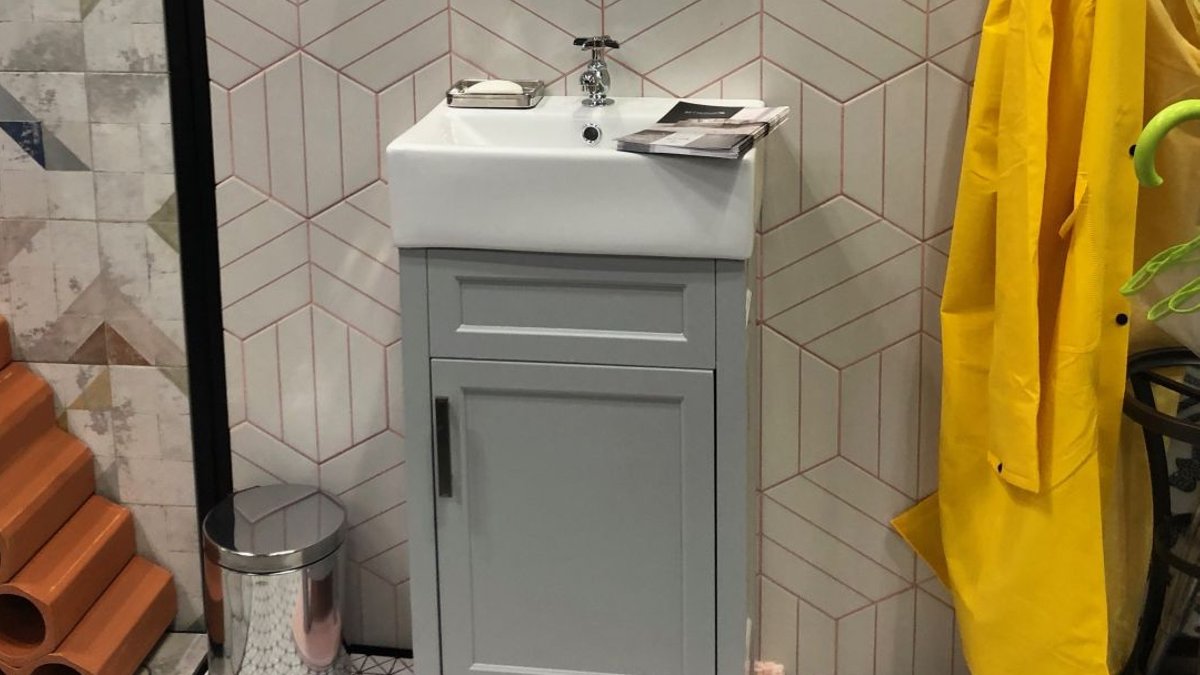
Standard bathroom cabinets are not the only option for housing a sink. Designers are replacing these bulky units with floating drawers, open metal supports, console-style furniture, and even fluted round bases that look more like decor than cabinetry.
Some installations leave plumbing visible. Others move storage away from the floor or separate it from the basin. One design places two sinks on a narrow metal frame, while another uses a cylindrical base to turn a corner into a highlight.
Variations in Vanity Style
These concepts apply to compact powder rooms, double-sink baths, and larger areas, demonstrating how much the look of a room can change when the traditional base cabinet is removed. Hanging a vanity keeps the floor clear on both sides, which reduces the visual bulk of a wide cabinet.
In this example, muted green drawers sit under a white countertop while a large illuminated mirror covers much of the wall. Open shelves hold towels and smaller items, meaning the vanity does not have to handle all the storage needs.
Two sinks do not require a tall unit that touches the floor. A long suspended cabinet gives each basin its own faucet and counter space while keeping the base minimal. Against the dark wall, the pale cabinet and glowing mirror create one horizontal visual.
Shifting from Traditional Storage
Swap out standard cabinetry for an open metal console, and you will see two deep rectangular basins resting on a thin black framework with an open shelf connecting them. Towels are now visible rather than hidden behind doors, and wall-mounted faucets help achieve this look.
Open Console Sinks
Without faucet hardware blocking the space behind the sinks, the console can remain narrow and open. Storage does not vanish when a vanity is raised. This white model uses a deep open compartment beneath the basin for bottles, towels, or baskets without sealing the base.
Its straight lines match the wall-hung toilet and recessed mirror, giving the room a collection of simple geometric shapes rather than a single heavy object. When the sink counter is separated from the storage below, the vanity breaks into distinct components.
A thin white sink counter runs across the wall, while a separate suspended drawer unit sits underneath. That gap alters the entire appearance. Plumbing stays visible, towels have a dedicated open spot, and the lower unit resembles a piece of furniture.
Black wall paneling and pendant lights make the white elements pop. Reintroducing the console sink, this room uses a broad white basin supported by a polished metal frame. The exposed base complements the paneled walls, traditional toilet, framed mirror, and herringbone floor.
It provides less hidden storage, but it stops another large cabinet from cluttering a space already full of architectural details. If you treat the vanity like an antique dresser, curved legs, a dark wood base, marble top, and bridge faucet distinguish it from standard bathroom cabinetry.
The sink is integrated into an item that appears to be furniture at first glance. An ornate mirror above continues this theme. Rather than hiding the vanity, the design treats the sink area with the same care given to a console or chest in a living room.
Vanity As Furniture
Give a small vanity a surprising front, and compact bathrooms can take bigger design risks since the cabinet takes up less wall space. Here, a square vessel sink sits atop doors with a black-and-white zebra pattern. Slim legs lift the cabinet off the floor, while a white frame contains the patterned doors.
The result converts a basic sink cabinet into an accent piece without adding more objects. Let the plumbing be part of the design, and a wide double sink rests on a polished metal frame, with pipes and supports exposed beneath. That open structure makes the sink feel lighter despite its size.
The oval mirror, wall lights, and textured white wall finish provide the decoration, eliminating the need for cabinet doors or hardware. Use a round vanity when a rectangle seems too heavy, as a narrow bathroom corner does not always need a scaled-down rectangular cabinet.
This fluted cylindrical base changes the footprint while creating a strong focal point under the vessel sink. The scalloped dark countertop follows the curves, and brass fixtures link the vanity to the mirror and wall storage. Its unusual shape utilizes a tight spot without looking like a compromise.
Place the basin on a table-like stand, and the sink station reduces the vanity to a top, four slim legs, and one shelf. The vessel basin provides most of the visual weight, while wood surfaces add warmth to the white frame. Storage moves to a separate vertical piece beside it, including a towel rail.
Splitting these functions keeps the sink area open instead of forcing the basin, drawers, towels, and toiletries into one cabinet. Curving the ends instead of using another box, this design shows that not every alternative must eliminate enclosed storage. This double vanity retains drawers, doors, and a broad countertop but abandons the usual straight-sided shape.
Unconventional Vanity Designs
Each basin has a wall-mounted faucet and illuminated mirror. This layout leaves the counter free of faucet bases and mirror frames that touch the surface. Pendant lights on one side break the symmetry and add another layer above the otherwise simple cabinet. Use an open brass frame against a bold wall, and the pattern dominates the background in this bathroom.
A solid cabinet would clash with one of the room’s strongest features. The open vanity leaves much of the geometric wall visible. Brass legs connect the sink to the mirror frame, faucet, towel bar, and accessories. White shelves provide just enough surface for bathroom items while keeping the base open.
Against the patterned wall and marble floor, the vanity feels more like a console table than bathroom cabinetry. The basin rests on a polished metal frame, with the pipes and supports left in view beneath, creating a unique and visually appealing design element.


Leave a Reply