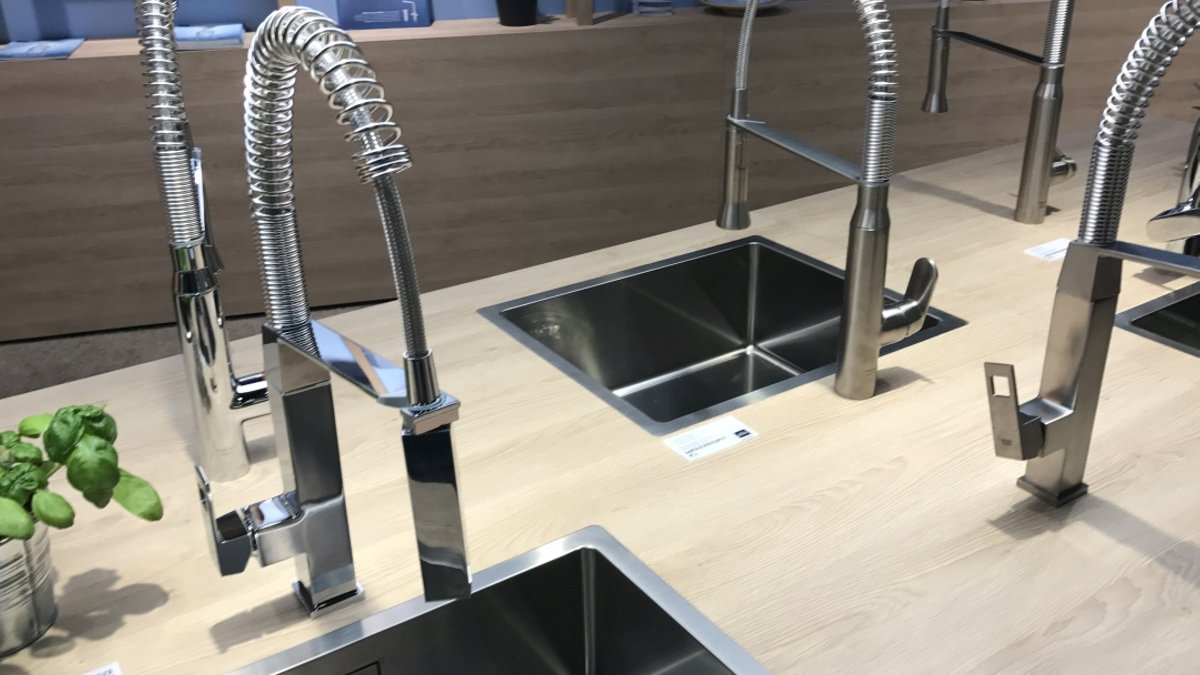
Traditional curved kitchen faucets are now being challenged by models that emphasize practicality rather than the classic arch. Although the gooseneck silhouette remains prevalent, makers are adding square angles, side-oriented spouts, and coiled springs to alter the way water is delivered to the basin.
Geometry Over Tradition
A quartet of faucets on display demonstrates the move away from the conventional curve. One unit retains a lofty, rounded arch, while two bronze pieces feature tighter turns and more compact heights. The stainless-steel option projects its spout forward at an angle instead of sweeping over the sink. Each model covers a comparable work zone, yet they achieve this through distinct mixes of height, bend and forward reach.
Dornbracht’s Maro eliminates the curved neck entirely. Its wide rectangular base rises from the countertop before angling forward into a spout with a squared corner. The handle remains near the bottom rather than spanning the body. Set against a white backdrop and a dark wall, the piece appears as a collection of geometric shapes rather than a typical gooseneck.
Read Also: Choosing bedroom furniture and finding a reliable furniture store in Chino
The Tara Classic from Dornbracht introduces the visible spring mechanism commonly seen on commercial pre-rinse stations. A tall, flexible neck lets the spray head travel beyond the fixed location of a standard spout. An arm supports the assembly, and a smaller companion fixture sits adjacent to it. This arrangement places additional hardware above the counter, allowing the spring itself to become the focal point of the sink area.
Separation of Functions
Dornbracht’s Tara Ultra retains the high-arched faucet but adds a separate cylindrical hand sprayer beside it. Rather than relying on the main spout for every task, the auxiliary unit can be lifted off the counter when water must reach another part of the basin. Both elements share a brushed-metal finish and cylindrical styling, expanding capability without thickening the faucet neck.
The Elio model from Dornbracht follows a different concept. Its spout bends almost at a right angle, terminating in a larger cylindrical section that houses the pull-out head. Control knobs are positioned next to the faucet instead of on its body, allowing the main fixture to focus solely on water delivery and resulting in a markedly lower profile than the tall arches shown elsewhere.
Read Also: Outdoor furniture stores near me: A guide for selecting patio furniture
Their upright bases flow into long horizontal spouts, ending in thicker sections that mark the functional end of each design. These proportions support a visual strategy that keeps most of the faucet’s mass close to the countertop rather than forming an arch above the basin.
Reconfiguring the Countertop
A matte-black finish paired with a black undermount sink does more than change colour; it visually unites the faucet and basin against a light countertop, presenting them as a single dark zone rather than two distinct items. The faucet forgoes a full arch, with its vertical neck turning forward into a straight horizontal arm, emphasizing the extended spout and cylindrical pull-out head.
A spring-coil faucet rises as the tallest feature on a wood-topped island, standing above a wide double-bowl stainless-steel sink. The flexible spray head hangs low enough to reach either side, while the coil extends high above it. Pendant lighting, dark cabinetry and built-in ovens line the back of the island, yet the faucet continues to dominate the work surface.




Leave a Reply