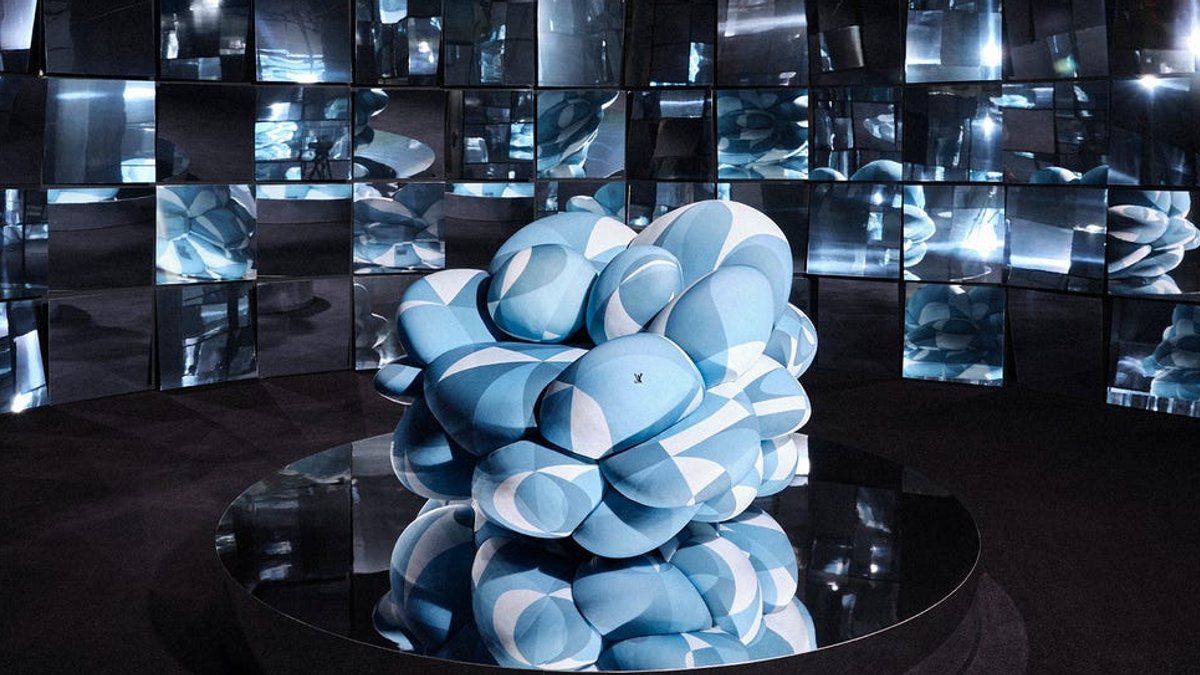
At Milan Design Week, Louis Vuitton returned to Palazzo Serbelloni to present its latest ‘Objets Nomades’ collection. The historic palace’s rooms held furniture, objects, and textiles from several international designers. One room stopped visitors: a mirrored space with a single chair at its center, designed by London-based studio Raw Edges.
Founded by Yael Mer and Shay Alkalay, Raw Edges created the piece called ‘Stella.’ It takes a two-dimensional textile covering and explodes it into three dimensions. Placed inside a hall of mirrors, the chair reads as much as an optical illusion as a piece of furniture.
Balancing studio identity with a heritage brand
Shay describes working with Louis Vuitton as a dialogue. When the studio starts something new, they say they immediately know when it could be a Louis Vuitton project. The maison, he says, is more willing to “embrace the crazy” than other brands and has the resources to invest in complex production methods.
“That’s not what you would expect, maybe, from a very elegant luxury brand,” he said, “but it’s exciting.” The brand’s willingness to take risks with shape and material stands out, even for a house known for its monogrammed trunks and classic leather goods.
Related: Dreamy Provençal Home Showcases Wicker Craftsmanship
Why a chair is not the hardest thing to design
Common wisdom says a chair is the hardest object for any designer. Shay disagrees. He calls that a myth. They approach a chair like any other three-dimensional object, he explained.
“When we designed this particular chair, we were so focused on this 2D to 3D concept,” he said. “Of course we made sure it’s comfortable, but the main focus was this sculptural quality and the craft.” Comfort mattered, but it wasn’t the driving force.
The prototype is not finished yet
Stella remains at prototype stage. Shay and Yael want to perfect it before moving on. They are working on the continuity between the bubbles that stretch across the chair’s surface.
“We try to have a core principle in the design that once you crack it, then it opens up more possibilities,” Shay said. “Once we understand how to achieve the continuity between those crazy bubbles, then we have ideas for more patterns that will express this idea of stretchiness.”
Related: Top Joiners for Bespoke Woodwork Projects Named
The upholstery here is not wrapped around the frame. It’s projected, distorted. “If you think about an upholstery pattern, you usually just wrap it. But here we’re not wrapping, we’re projecting and it’s really distorted,” he said. “We want to make sure this idea – the real DNA of the project – is what you see as soon as you observe the object. That’s the beauty of working with the brand because they get the idea, and then they push. We know the next prototype will be perfect.”
Travel and the atelier in Asnières
The designers visited the brand’s historic atelier in Asnières, outside Paris. There, craftspeople still build the brand’s trunks by hand. Shay said they saw folding beds, umbrellas, and lots of mechanisms. Yael noted the atelier’s history with materials like coated cotton.
“They were also very inventive in terms of materials, like coated cotton,” she said.
That trip shaped their understanding of what the brand could do. The atelier’s capabilities, they said, opened doors for ideas that would be hard to realize elsewhere.
Related: Healthy Home, Happy Life: The Importance of Maintaining a Clean Living Environment
London spirit or good collaboration
When asked whether the studio brings a particularly London spirit to a French house, the designers hesitated. Yael said it’s hard to tell from the inside. Shay pointed out that London is a multicultural city, much like the brand’s own international design team.
He described the relationship as intimate and personal, built on a high level of trust. “We don’t see this big brand with this massive powerhouse that is behind them,” he said, smiling. The scale of the company doesn’t dominate the working relationship, at least not from their perspective.
Working with artisans, limits and all
Shay said working with its artisans feels limitless, but also constrained. “In a way there are no limits to what you can do, but at the same time everything has a limit. It’s this balance between how you work with people with amazing capabilities, yet understanding the limitations of material and production. That’s the fun.”
Yael focuses on three-dimensional geometry. She works closely with fabricators who cover objects with leather. Yael recalled instances where language barriers didn’t matter — they understood each other through body language and shared knowledge of materials. “You know exactly how well they know the material, there is this understanding,” Yael said.



Leave a Reply