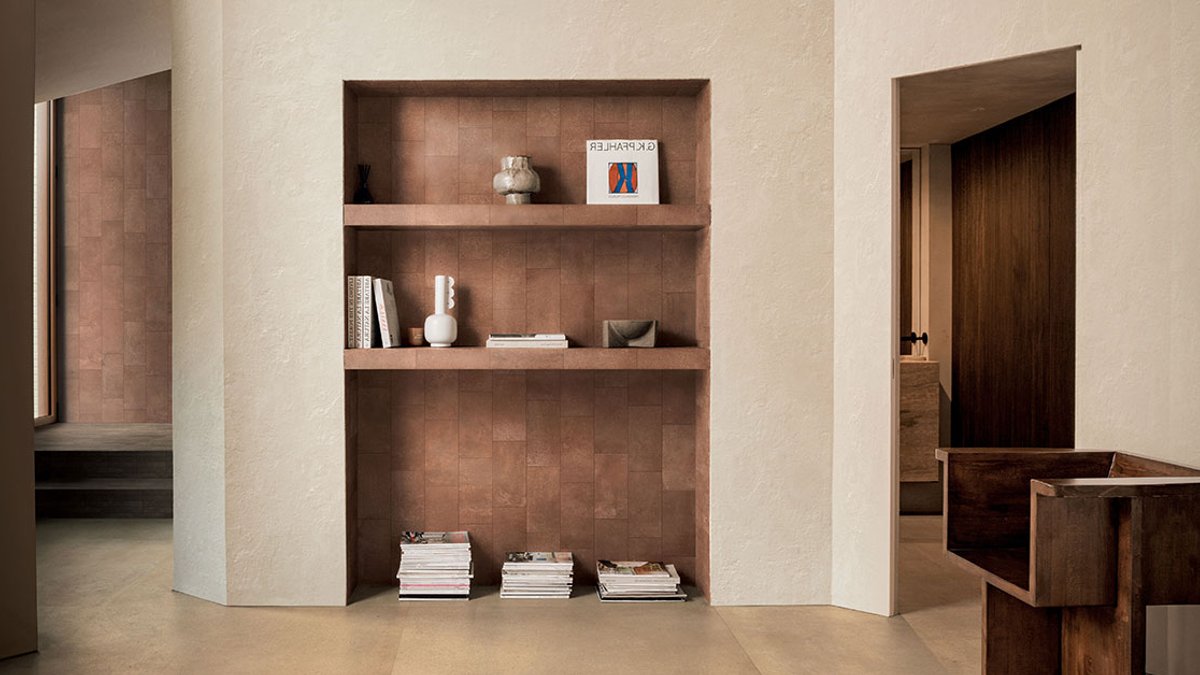
The latest collaboration between Italian tile manufacturer Florim and architect Matteo Thun turns ceramic surfaces into something that looks—and feels—handmade. Called SensiTerre, the collection builds on years of shared experimentation, distilling the warmth of artisanal craft into large-format porcelain tiles.
The emotional roots of a technical material
The project traces back to Venere Bianca, a series of terracotta vases Thun designed with Benedetto Fasciana and Bitossi a decade ago. Those vases, with their archetypal shapes and Renaissance-inspired tool marks, became the emotional blueprint for SensiTerre. Instead of replicating the forms, Florim translated the spirit of the vessels—imperfections, textures, and all—into a surface meant for floors and walls.
Six muted yet rich colors—Cotone, Sabbia, Rosato, Mattone, Amaranto, and Carbone—evoke the dusty tones of worked clay. The finishes do more than mimic; they recreate specific techniques. Naturale preserves the raw matte feel of unfired clay, while Grana references cocciopesto, the ancient Roman mortar made from crushed brick. Rigatino and Cannettato reproduce the combing and engraving marks of the original vases, adding a tactile quality that invites touch.
Scale without sacrifice
SensiTerre isn’t just about aesthetics. The collection is designed for flexibility, with modular small and large formats that adapt to any space. The tiles are meant to be experienced visually and physically—what Florim describes as a surface to be “touched with the eyes and seen with the fingers.”
Related: Aren’t & Pyke Soften Federation Home with Stone and Colour
That sensory appeal comes without environmental compromise. The tiles are produced in facilities that recover 100% of raw production waste and wastewater. The plants are B Corp-certified and generate up to 100% of their own electricity, supplementing with certified renewable energy when needed. The result is a product that balances beauty and responsibility, a rare alignment in an industry often forced to choose between the two.
For designers, the collection offers a way to bring the authenticity of handcrafted materials into large-scale projects without the limitations of traditional ceramics. The challenge, as always, will be ensuring the tiles are used in ways that honor their tactile origins—rather than smoothing them into another generic finish.
The real test of SensiTerre may not be in its technical execution, but in whether it can retain its emotional resonance once it leaves the showroom. A tile that looks like it was shaped by human hands risks feeling out of place in a space that treats surfaces as purely functional. The best applications will likely be those that let the material’s imperfections tell their own quiet story.




Leave a Reply